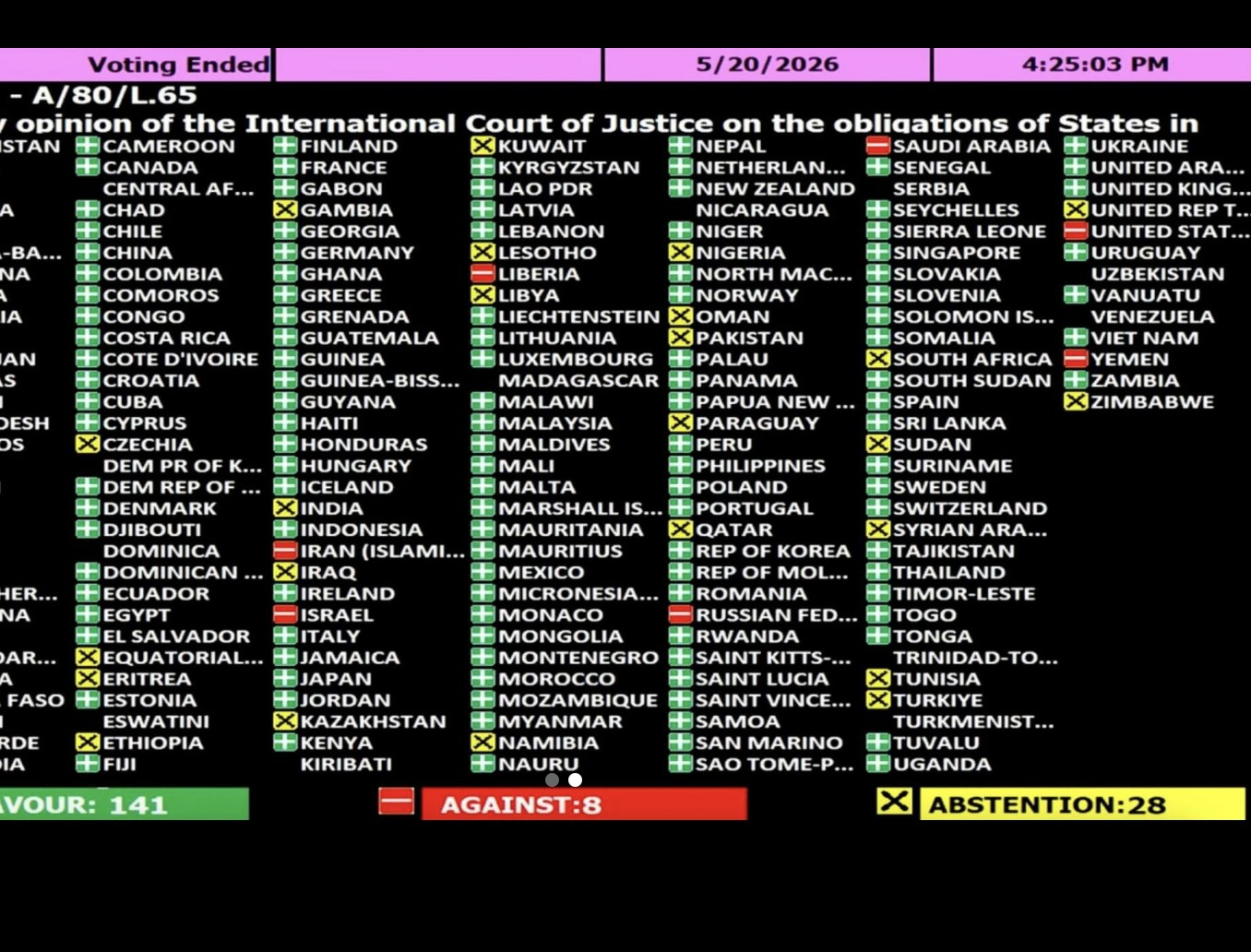
On 20 May 2026, the UN General Assembly (UNGA) voted to adopt a resolution in support of the implementation of the advisory opinion on the legal obligations of states on climate change, which was issued by the International Court of Justice last year. The resolution welcomes the advisory opinion as “an authoritative contribution to the clarification of existing international law”, calling on governments to comply with their international legal obligations. It also initiates a follow up process within the UNGA to support the implementation of the ICJ’s opinion. The resolution was the imitative of Vanuatu and a group of like-minded countries, resulting in 141 countries voting, eight against, and 28 abstentions.
The last few years have been important for the courts. Climate litigation has stepped in to fill the gap where many national governments have failed, oftentimes finding that more climate action is needed, be it of States or private companies. The ICJ’s advisory opinion falls into this category, by finding that all States have both customary (non-treaty) as well as treaty law obligations to respond to the climate crisis. The opinion matters because, while in itself not legally binding, it will have an influential value in courts and tribunals across the world. Building on this, the UNGA vote in support of its implementation has been received as a boost for multilateralism and international climate frameworks, including the Paris Agreement.
The ICJ’s findings have been debated by States and scholars of the past year, with different interpretations of the opinion’s meaning and reach. Now, the UNGA resolution takes this further, through a vote with its own interpretation and summary of the opinion. It is impactful because it is the first simple majority vote that all countries have taken on what their climate change related legal responsibilities are, without the veto power of petro-States that has bedevilled COP decisions to date. In this way it theoretically opens a pathway for a parallel more democratic approach to clarifying the legal obligations of States and, more importantly, in deciding on steps to implement them. In theory the UNGA process, like the Santa-Marta conference on transitioning away from fossil fuels, could be another forum within which to overcome the inertia that has seized the COPs.
Second, the UNGA resolution has more authoritative weight than an academic or country opinion insofar as it is a viewpoint expressed by 141 States who voted in favour of the resolution. It signals commonality, interest and appetite for a unified position on the legal obligation of States in relation to climate change and is indicative that there is still hope for a multilateral process governed by a legal order.
Lastly, the UNGA vote is self-reinforcing. In themselves UNGA resolutions are not legally binding, but they are highly influential and used by courts to determine and interpret customary international law. In its own way, the UNGA vote can now be used by courts together to interpret and apply the ICJ opinion to cases before them. This is why the content of the resolution and how it interprets the ICJ opinion is so important.
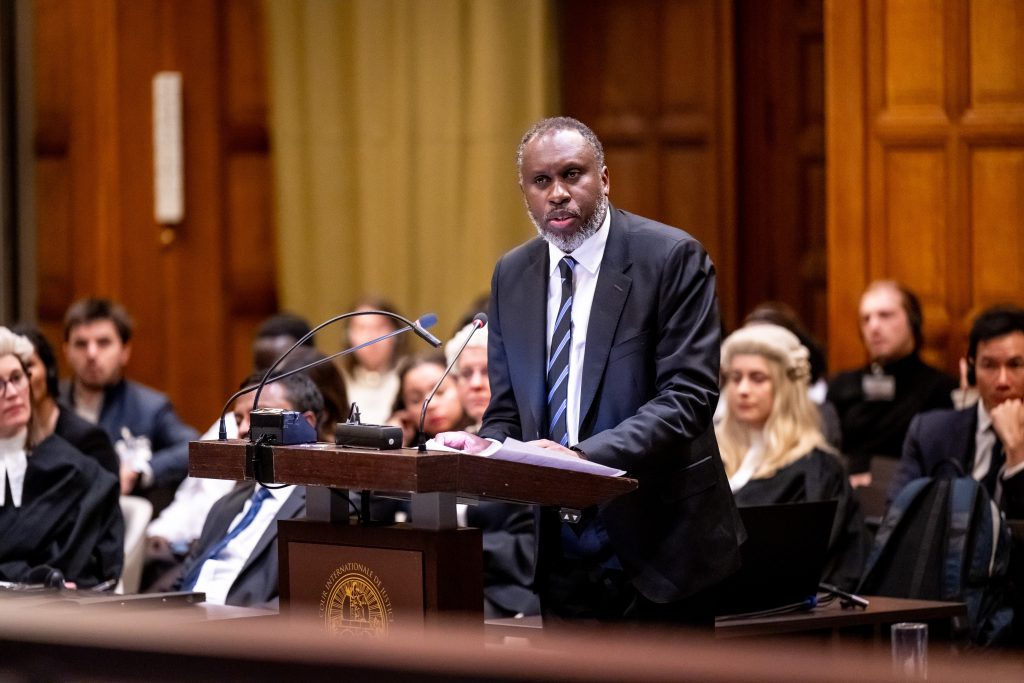
But the vote at the UNGA was no uncontroversial. Eight states voted against it, namely, Belarus, Iran, Israel, Liberia, the Russian Federation, Saudi Arabia, the US, and Yemen, with 28 abstentions. Two abstentions were surprising and awkward. COP31 host for this year, Türkiye, elected to abstain, as did South Africa, which is home to one of the sitting judges that penned the ICJ advisory opinion, Judge Dire Tladi.
Other notable abstentions were India, Qatar, and Nigeria. But they were not alone. Ethiopia, Equatorial Guinea, Eritrea, the Gambia, Libya, Lesotho, Namibia, Sudan, Tanzania, Tunisia, and Zimbabwe all abstained, with 13 African countries making up almost half of all the abstentions.
Why so many? Not all countries were open about why they voted in a particular direction, but South Africa gave a flavour about its concerns in an open letter shared a few days after the vote. Its logic, it argued, “was aimed at defending the integrity of the global climate framework”. While it in principle “welcomed” the historic ICJ opinion, it felt that the final text of the UNGA resolution was selective in focusing on some elements of the opinion.
According to South Africa, it also failed to reflect, and in fact weakened, core principles of the international legal architecture, such as common but differentiated responsibilities (CBDR), and the duty of developed states to take the lead with emissions reductions. The country argued that the UNGA text “interprets the Court’s opinion in a manner inconsistent with the bedrock principles of the [UNFCCC], Kyoto Protocol and Paris Agreement” Further, the country took issue with the failure of the UNGA text to explicitly recognise the unique vulnerability of African states.
This is South Africa’s view and it is not necessarily shared by the other 12 African states that abstained. It is also a long held view by South Africa that has surfaced in the negotiations particularly on CBDR and it has been repeatedly raised by the country in COP discussions around the global stocktake, the mitigation work programme, and the delicate relationship between GHG mitigation and finance.
It is also possible that many other African countries voted for reasons not directly germane to the ICJ opinion, for example to preserve ties with nations it has close ties to – Lesotho’s delicate tariff and trade relationship with the United States (which opposes the ICJ opinion) comes to mind. But the South African position, if shared between other African countries, does share one firm characteristic – a desire to elevate CBDR as a make or break item, even if it means foregoing the option of a more forward and workable path to implementing the ICJ opinion.
But the African countries that abstained are in the minimum, with a majority of African countries voting in favour. The BRICS+ group, which has historically been a strong contender of CBDR, did not vote uniformly on the issue. Brazil and China were in favour of the resolution, while South Africa, and India abstained, and Russia was against. BRICS+ newcomers Egypt, Indonesia and the UAE were in favour, Ethiopia abstained, and Iran and Saudi Arabia were against it reflecting voting along national as opposed to regional or bloc interests.
Unsurprisingly the United States was opposed to any steps to give the ICJ opinion further impetus, arguing that “the resolution improperly treats the Court’s opinion as irrefutably authoritative and as setting out binding obligations on States.” The country posited that the resolution was “highly problematic in calling on States to comply with so-called obligations that are based on non-binding conclusions of the Court on which UN Member States’ views diverge”, ultimately painting the opinion out to be an unlawful overreach into the sovereign rights of states to govern their own energy policies.
The advisory opinion calls on all countries to comply with their customary law and treaty obligations. It also reiterates elements of the Global Stocktake not found in the ICJ Opinion, such as tripling renewable energy capacity, doubling energy efficiency by 2030, transitioning away from fossil fuels in energy systems, and phasing out inefficient fossil fuel subsidies. The mention of fossil fuels in the final resolution is important as this issue proved to be insurmountable in the COP final outcome text last year and in the year prior. Again, this all hints at what can be achieved through a simple majority vote, higher ambition in a textual outcome.
The resolution concludes by requesting the Secretary General to submit a report containing ways to advance compliance with the Court’s findings, taking into account the latest science and possible gaps in multilateral efforts. It also includes as a provisional agenda item for the next UNGA session, a “follow up” on the ICJ advisory opinion.
Having embedded itself within the UNGA, the next step is for the body to consider how it wants to operate alongside the COPs, if at all, and the practical pathways to implementing the ICJ advisory opinion, guided by the Secretary General’s report.
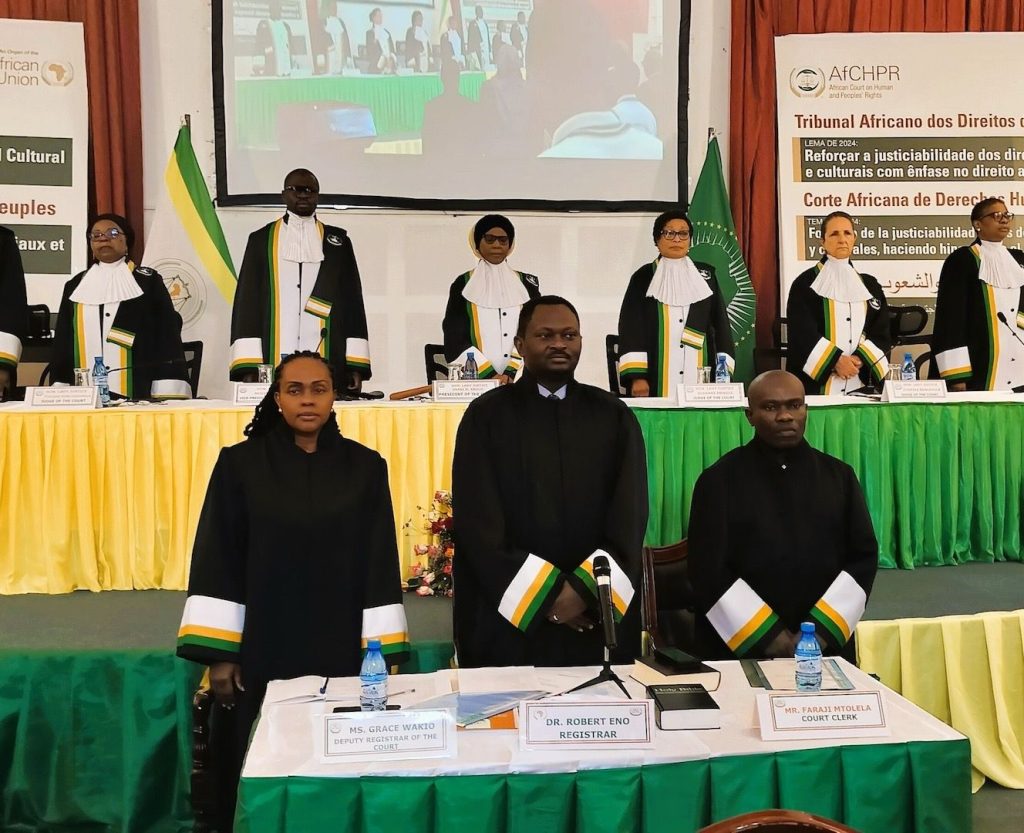
Notably, the African Court of Human and Peoples Rights is currently seized with an application for it to issue another advisory opinion on climate change, human rights and the legal obligations of States in Africa. If the same route as the UNGA is followed, and with the right champions, it could potentially see the African Union’s heads of State and Government consider the finding of the African Court’s advisory opinion in the next few years.
Either way, the 13 African countries that abstained at the UNGA vote will need to consider how they wish to position themselves within the UNGA process and discussions on climate action therein. They can continue to push for references to CBDR and equity as the parallel process unfolds, but they may continue to find themselves in the minority.