
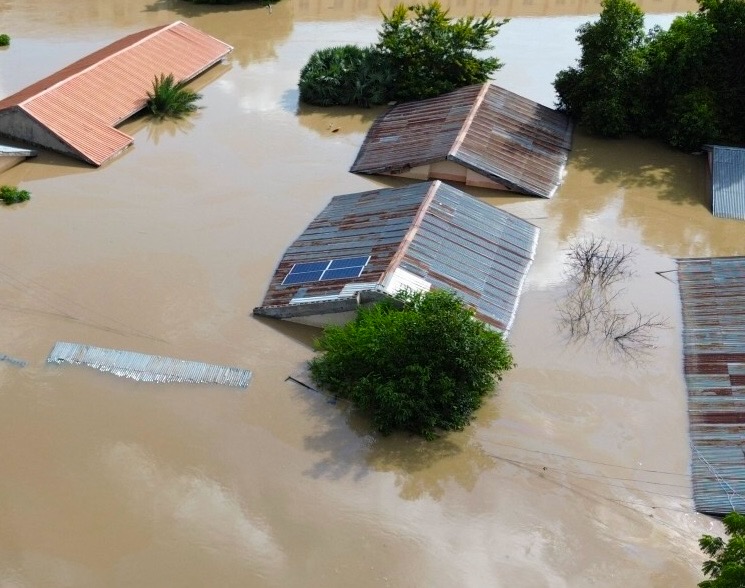
When the Alau Dam collapsed in the middle of the night on 10 September 2024, Fati Laminu was still awake. Local officials had come earlier that evening urging residents in her part of Maiduguri, Nigeria, to fill sacks with sand. She did. Her husband did. Their children helped. It wasn’t enough. By the time the water reached her chest, strangers were pulling her family to safety. By morning, her home, her belongings, her neighbourhood were gone.
I think about people like Fati a lot when I’m sitting in negotiating rooms, watching delegates argue over brackets and timelines. There is always a gap – sometimes a chasm – between the language of international climate diplomacy and what is actually happening to people on the ground.
The floods that swept through Maiduguri killed at least 37 people, displaced close to 400,000 and destroyed crops at the height of the lean season when food stocks were already desperately thin. In northern Nigeria, 32 million people were already facing acute hunger before the dam broke. The floods struck a region already in crisis.
What the jargon doesn’t capture
‘Loss and damage’ describes something very real – and something most Africans understand instinctively. It refers to the harm caused by climate change that we can no longer avoid through reducing emissions and can no longer minimise through adaptation. It is what remains after every other option has run out.
For a continent that contributed less than 4% of global greenhouse gas emissions driving this crisis, Africa is absorbing an extraordinary and unjust share of the consequences.
In 2022 alone, African countries lost close to USD $9 billion to climate-related loss and damage. In 2024, the continent experienced one of its hottest years on record; floods affected over 700,000 people across East Africa; Southern Africa endured the worst drought in a century; and in the Sahel, more than 1.2 million people were displaced.
What is often framed as a future climate risk is already a lived reality for communities across Africa.
A fund exists, but communities are still waiting
After years of advocacy – and CAN Africa’s member organisations have been in this fight for a long time – the world finally agreed at COP27 in Egypt in 2022 to create a dedicated fund for loss and damage. At COP28 in Dubai, countries operationalised it. They appointed Ibrahima Cheikh Diong of Senegal as its first Executive Director and pledged around USD $673 million to get it started.
Let me put that number in context. Researchers estimate loss and damage needs for vulnerable countries were somewhere between USD $128 billion and USD $937 billion in 2025 alone. The fund now holds about USD $790 million in pledges, of which only a fraction has actually been transferred. At COP29 in Baku, decisions on how to get money to affected communities, how to set eligibility criteria, how to make access simple enough for countries that don’t have armies of climate finance lawyers – all of that was deferred.
Deferred. That word does a lot of work in climate negotiations. It is a polite way of saying: not yet.
At COP30 in Belém in November 2025, the Fund officially opened for business under the Barbados Implementation Modalities. That is genuine progress. But the summit saw very little new money flow into the fund’s coffers, and loss and damage received, in the words of several observers, “relatively little attention” compared to previous COPs.
What COP31 needs to deliver for African countries
COP31 will be held in Antalya, Turkey in November and African negotiators alongside civil society organisations across the continent are going into it with a clear set of demands that go beyond what Belém delivered.
The first is access. Climate funds have a consistent history of being hard to reach for the countries that most need them. Eligibility criteria are opaque. Application processes are slow and complex. The administrative burden falls on governments that are often already overstretched, and direct access is non-negotiable.
The second is scale. The USD $1.3 trillion climate finance target agreed at COP29 and reaffirmed at COP30 is the right number, but it needs a meaningful loss and damage sub-goal with real accountability. For countries already dealing with irreversible climate harm, the real question is not the size of the headline number, but what support will actually be available.
The third is coherence – and this is where the idea of a just transition has to be reclaimed. For African countries, a just transition must mean more than cleaner economies. It must mean public systems resilient enough to protect the communities most exposed to climate shocks, financed by those most responsible for causing them. Right now, three parallel mechanisms – the Fund for Responding to Loss and Damage, the Warsaw International Mechanism and the Santiago Network – operate without the coordination they need. Countries hit by climate disasters often don’t know which door to knock on. The State of Loss and Damage Report agreed at COP30 gives us a way to document those gaps. This is a tool we can use. But documenting the gaps is not enough.
The distance between a pledge and a rebuilt home
Back in Maiduguri, a relief distribution committee concluded its work with 4.45 billion naira (USD $3 million) unspent, amid widespread calls for transparency and accountability. Many survivors never received any support at all. The federal government promised 80 billion naira to rehabilitate the Alau Dam. As of early 2026, work had not yet begun, with another rainy season approaching.
The parallel global state of affairs is uncomfortable but instructive. At both levels – local and international – the same dynamics play out. Funds are announced. Disbursement is delayed or misdirected. Communities rebuild largely on their own. Trust erodes slowly, then suddenly.
Nigeria, like most African countries, has no national loss and damage insurance scheme and no meaningful access yet to the global fund. What loss and damage finance is supposed to offer is something different and more ambitious: recognition that these events have causes, not just consequences, and that those who caused the most harm owe concrete support to those suffering the worst of it.
There will be a COP31 in Antalya. There will be negotiations, communiqués, and pledges. Advocacy groups will be in those rooms, making the case that the distance between a negotiating text in Turkey and a family rebuilding after a flood in Nigeria or a drought in Zambia is not a technical problem. It is a political choice made, year after year, by governments that have the means to act and have so far chosen not to do so – instead they have chosen delay, partial action, and measures far short of what the science and the suffering demand.
Fati Laminu filled sandbags by the light of her phone. She did everything she could. The world’s wealthiest nations have not yet done the same.
**Baboucarr Nyang is a Regional Coordinator at CAN Africa (Climate Action Network Africa).