The African Union’s 39th Summit held earlier this month, reinforced the region’s ambitions for greater integration between African countries, policy autonomy and reform of global institutions. Heads of State reiterated the importance of more equitable access to finance, a longstanding issue in climate circles that exacerbates public debt, constrains spending on climate change, and makes access to climate finance more expensive. They also wanted higher levels of representations in global institutions such as the UN Security Council. Momentum continued to gather around the prospects of greater regional integration following the African Continental Free Trade Agreement (AfCFTA), with the hope of it propelling intra-African trade, shifting import dependence and advancing an industrialisation strategy for the continent.
Water and Climate
The official theme of sustainable water supply and sanitation was relatively overshadowed by these topics, but still remained high on the agenda. Water as infrastructure investment was a recurring refrain, with many institutions renewing their commitment to financing what they had committed to last year. Ahead of the Summit, the Global Water Partnership indicated that it would relocate its headquarters from Sweden to Namibia, one of the most arid countries in Africa, to be closer to the US$10 billion–US$12 billion portfolio emerging from the AU-led process.
Many speakers underscored a similar approach to water sustainability that they have in relation to climate change: focus on integrating water/climate into national economic strategy and industrial policy, and create platforms upon which to matchmake investments. Notably, the Africa Investment Programme, which held a water summit last year under the auspices of the AU, featured 80 investment-ready water projects from 38 African countries, with a combined portfolio value of approximately US$32 billion. More than 180 private companies and financial institutions participated, an important outcome mindful that water investments have historically been perceived as less financially attractive.
This aligns with recent trends to develop climate change adaptation investment platforms that were strongly supported by the European Investment Bank, Global Centre on Adaptation and others last year, as well as the COP30 decision text which encourages countries to create NDC investment plans. At the Summit, African Group of Negotiators (AGN) Chair, Nana Dr. Antwi-Boasiako Amoah, shared his support for climate change investment platforms, when he called for a shift from “fragmented, project financing, towards programmatic, regional investment platforms, capable of transforming entire sectors and value chains.”
The sentiment was not just on the need to attract finance, support project pipelines and enable regional platforms, but to ensure that industries already operating in the continent localised water related benefits. At one meeting, South African Water and Sanitation Minister Pemmy Majodina said: “the mining houses — they have money. They must invest in water. They must invest in infrastructure.” The statement echoes similar refrains across the Summit the need for local beneficiation and for value from critical minerals to remain on the continent.
AfCFTA, Industrial Policy and Climate
To anchor this investment, many pointed to the AfCFTA, as the biggest and boldest opportunity to reshape Africa’s development, with its potential to increase intra-African trade by up to US$3 trillion, create structural economic transformation and deepen value addition. Speaking at the summit, Kenya’s President William Ruto described its potential as immense, but underscored the need for accelerated implementation and sustained political leadership.
AGN Chair, Dr Amoah, also highlighted that the AfCFTA offered a platform to aggregate regional markets and address scale constraints, in the context of global unilateral trade measures, carbon border adjustments and green subsidies that were reshaping international trade and posing risks to African economies. Within AfCFTA, however, he stressed the need to preserve policy space for green industrial strategies and differentiated transition pathways.
A draft regional industrial strategy is currently under review within the AfCFTA aimed at shifting Africa from exporting raw materials to creating regional value chains, and may be presented to African ministers soon. Integrating low carbon energy, just transitions and climate resilience within this strategy and other national industrial strategies is critical to ensure cross-sectoral integration. To this end, Amoah stressed that energy sovereignty, industrial policy and access to finance must be central to Africa’s climate strategy, and he urged stronger coordination among African institutions to address fragmentation between mandates and implementation.
For Amoah, the Just Transition must go beyond worker protection to encompass national development and shared prosperity. “For Africa, a just transition must mean manufacturing solar panels, batteries and green hydrogen components on the African soil. It must mean local beneficiation of critical minerals, supported by skills development and meaningful technology transfer,” he said, warning that a green transition that leaves Africa confined to exporting raw materials at the bottom of global value chains could not be described as just. Ultimately climate diplomacy must strengthen Africa’s industrial ambitions and economic security.
National Security
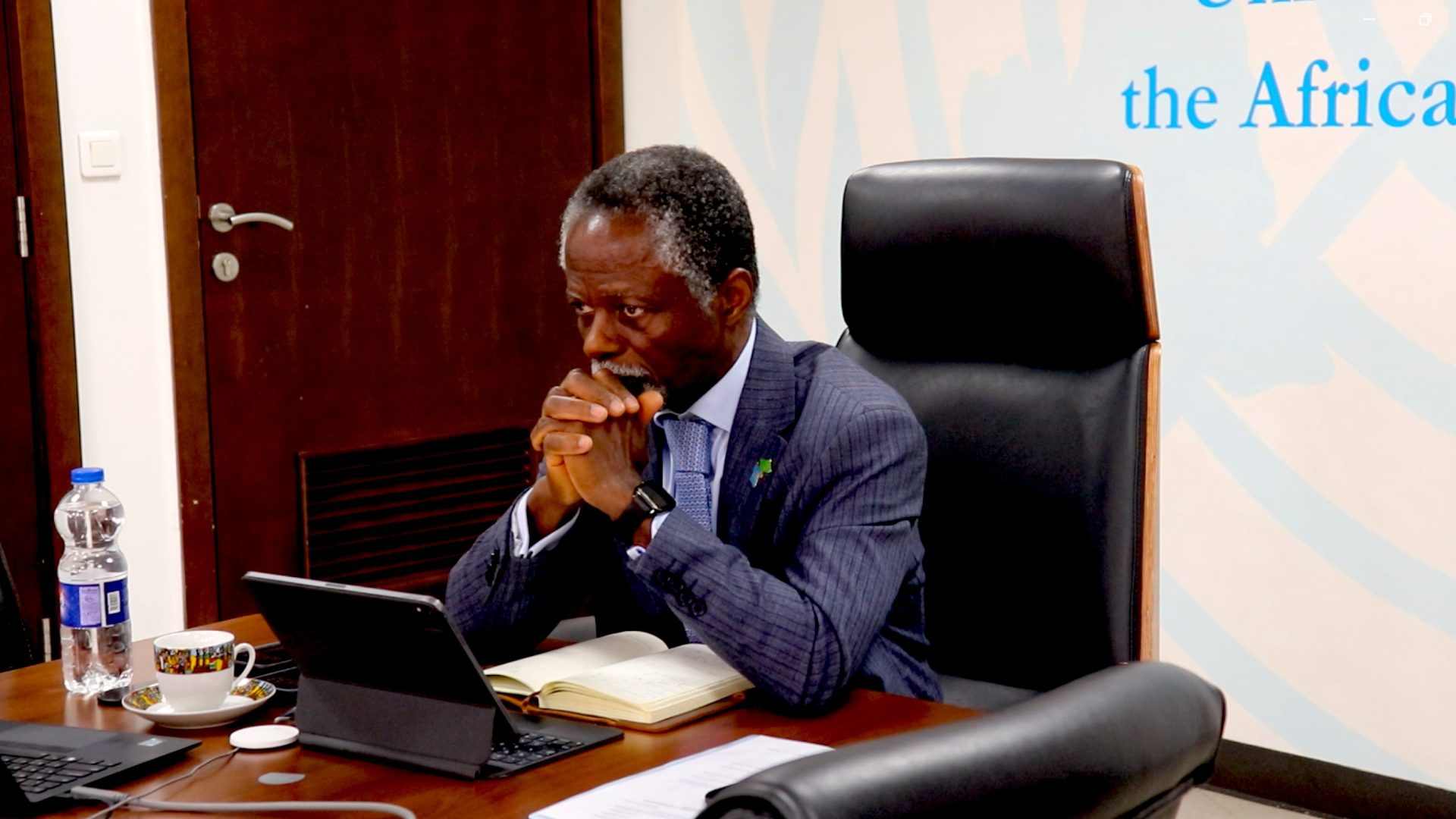
Climate change and national security featured strongly at the Summit. While conflicts in Sudan, the Sahel and eastern DRC dominated many discussions, the open session meeting of the AU’s Peace and Security Council held alongside the Summit also underscored the centrality of climate change to peace and security in the region. Parfait Onanga-Anyanga, Special Representative of the Secretary-General to the African Union and Head of the UN Office to the African Union warned that that climate shocks are intensifying competition over land and water, undermining livelihoods, displacing communities, enabling armed groups to exploit natural resources, and straining already fragile state systems. “The question is no longer whether climate change influences peace and security. It does,” he said. “A world in climate chaos cannot be a world at peace.” This means that adaptation must now be a fundamental pillar of stability, peace and security measures, and that climate proofing food systems and water resources and supporting renewable energy were an important element of conflict prevention.
His comments followed directly on from those of Simon Steill, Executive Secretary of the UNFCCC who, a few days prior at a press briefing on COP30 outcomes, warned that while security is high on the agenda of many nations at present, “many cling to a definition that is dangerously narrow”. In an attempt to refocus global attention on climate change which has been overshadowed by security concerns, he emphasised that “for any leader who is serious about security, climate action is mission critical, as climate impacts wreak havoc on every population and economy.”
The AU has already made significant progress on this issue through the African Leaders Addis Ababa Declaration on Climate Change, that affirms climate change as a conflict risk multiplier and calls for strengthened conflict sensitive adaptation responses. There is also momentum behind the Common African Position on Climate Change, Peace and Security, with Onanga-Anyanga describing it as a landmark effort to establish a coherent continental framework and a global precedent.
Representation
Lastly, African leaders continued to push for more equitable access to finance and representation within global institutions. Secretary General of the United Nations, Antonio Guterres called the absence of permanent African seats on the UN Security Council “indefensible.” While the continent deserves a seat at the table, and while its approach to climate change and peace will be precedent setting worldwide, the AU itself has been criticised for its laggard pace in translating declarations into action, its ability to deal with conflicts within Africa and its caution in intervening in disputed elections. There is a perception that it prioritises government stability and shields the beneficiaries of liberation regimes at the expense of accountability, a perception it will need to take active steps to overcome if it is to lead on security matters, especially those that are climate change related.